
CPF’s History, Growth & Future
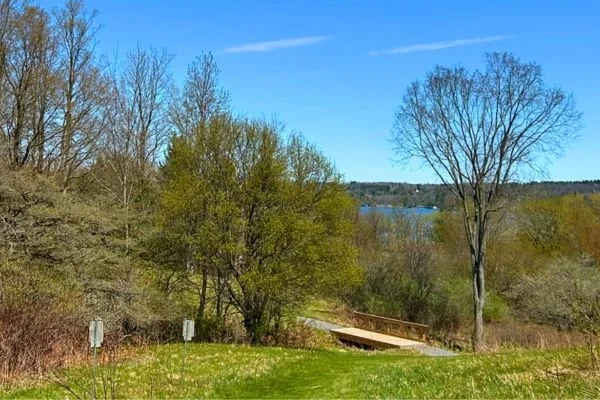
View from the top of Fairchild Hill trail with Cazenovia Lake visible in the distance. (photo by MK Gutierrez)
CPF’s History, Growth & Future. This is a busy time of year for land trusts, and as the Cazenovia Preservation Foundation (CPF) begins its next season of land stewardship, conservation project work, and public events, we pause to reflect upon how the organization began, the ways in which it has evolved, and where it is today.
Starting in the Village
CPF began in 1967 with a small group of passionate volunteers who wanted to preserve the aesthetic character of the Village of Cazenovia. In those early years, CPF focused on architecture and the built environment—documenting buildings so that the downtown area could be listed as a historic district on the National Register of Historic Places. These efforts helped ensure that Cazenovia would retain its unique charm. CPF now holds fourteen easements that include historical architectural protections within the village and in the surrounding areas, including the Cazenovia Public Library, the Lincklaen House, and the Lehigh Valley Railroad Depot.
Expanding the Scope
In the mid-1980s, nearly two decades after its founding, CPF’s work expanded to include land conservation. The organization envisioned establishing a protective “hard edge” greenbelt around the village center, in part to provide those traveling into the village with a sense that they had arrived at a distinct “place”—a term used in the field of landscape architecture to describe a concept that goes beyond physical space and conveys a distinct cultural identity. As a step towards creating this greenbelt and maintaining the scenic viewsheds surrounding the village gateways, CPF purchased its first property—25 acres known as Fairchild Hill at the south end of Cazenovia Lake.
In 1987, CPF added a new tool to its conservation toolbox—the “buy-protect-sell” transaction—when the Meadows Farm on Rippleton Road, currently the home of Albanese Longhorns, was listed for sale. The CPF Board recognized the importance of the open space, scenic and architectural resources of this property, located at the southern gateway into the village. CPF purchased the farm in order to put a perpetual conservation easement in place. Once the provisions limiting sub-division and protecting the historical architectural resources were established, the property was put back on the market, and sold to a conservation-minded buyer.
Land Trust Terminology
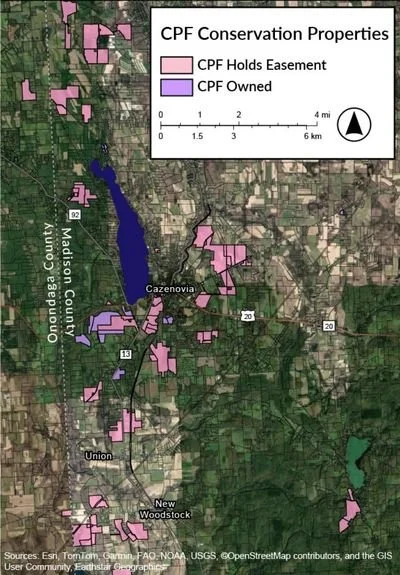
Owned properties, often called preserves, are lands that the land trust owns outright and manages for habitat protection and public recreation. Land may be donated by a landowner or purchased directly using grants, private donations, or a combination of funding sources, often at below-market value.
Easement Properties are conserved using a voluntary legal agreement between a landowner and a land trust that protects a property’s natural, agricultural, and/or historic character. The agreement limits future development while allowing the landowner to retain the ownership and use of their land.
Conservation easements are permanent, recorded with the County Records Office, and remain in effect when the property changes hands. Placement of conservation easements may be funded through grants or private donations.
Unlike preserves, easement properties are generally not open to the public. The land trust conducts periodic monitoring and works with landowners to ensure the terms of the easement are upheld.
Building Connections
Over the next few decades, CPF continued to acquire properties for protection, including a portion of the abandoned railroad bed between Cazenovia and New Woodstock—now part of the South Trail, as well as Carpenter’s Pond and the Willow Patch within the village. The preservation of these properties helped maintain open space and expanded the public’s access to nature.
Land donations played a key role in CPF’s success; gifts from generous donors helped create the popular Burlingame Trail System. Recognizing the value of conserving land adjacent to areas already protected, CPF has continued to purchase neighboring acreage when opportunities become available.
Evolving the Mission
As our understanding of the importance of ecosystem functions, habitat connectivity, and farmland conservation has increased, CPF’s mission has shifted from focusing on the human experience of place to protecting natural and agricultural resources.
In 2007, CPF utilized a new tool to further its conservation goals. CPF worked with the Town of Cazenovia and Critz Farms to successfully apply for a Farmland Protection Implementation Grant.* Critz Farms became the first property in Madison County to be permanently protected through this New York State Purchase of Development Rights (PDR) program.
Since that initial PDR project, CPF has partnered with landowners across multiple towns to conserve farmland through the purchase of development rights programs and through private conservation easements donations.
In 2022, New York State initiated a purchase of development rights program for forestland conservation. Soon after, CPF won a grant through this Forest Conservation Easements for Land Trusts program to protect 467 forested acres in the southeastern corner of the Town of Cazenovia.
Together, these efforts support CPF’s broader goal of connecting conserved lands around Cazenovia—protecting key corridors, natural habitats, and a critical mass of valuable agricultural land throughout the region.
Today, CPF is an accredited land trust serving Cazenovia and surrounding areas of Madison and eastern Onondaga Counties. Building on its history, CPF has evolved to embrace a more holistic conservation mission, integrating historic, agricultural, and natural resource protection across a comparatively small—but gradually and thoughtfully expanding—geographic footprint. This broad perspective has made CPF a sought-after and valued participant in community and comprehensive planning efforts. CPF contributes important conservation priorities and insights to larger conversations about land use and long-term community development.
Looking Forward
CPF continues to build on its momentum. In 2025, sisters Susan Schapiro and Sally Vernon decided to donate 370 acres of their family farm along the shore of the Eatonbrook Reservoir to CPF. This remarkable property—featuring wetlands, agricultural fields, forest, and historic barns—will be the focus of a multi-year planning effort to create a new public preserve.
In addition, CPF is currently working with four area farms—representing a combined 920 acres—on their applications to NYS’s FPIG program.
With the support of its members, CPF will continue to expand its efforts to protect the historic places that define our region and preserve the farmland and natural habitats essential for future generations.